01
Cyberpunk Games
From immersive sims built around a hackable world to open-world RPGs built around a hackable body, plus the tabletop system that seeded the biggest of them.
Read the guide →Genre guide
Cyberpunk didn't start as a mood board. It started as a specific argument — that high technology concentrates power rather than distributing it, that the future arrives unevenly and lands hardest on the people least equipped to refuse it. Everything that reads as "the aesthetic" — the neon, the rain, the chrome — grew out of that argument, in fiction first and then in film, games and street style. This site works through all four, guide by guide, on their own terms.
Jump to the five guides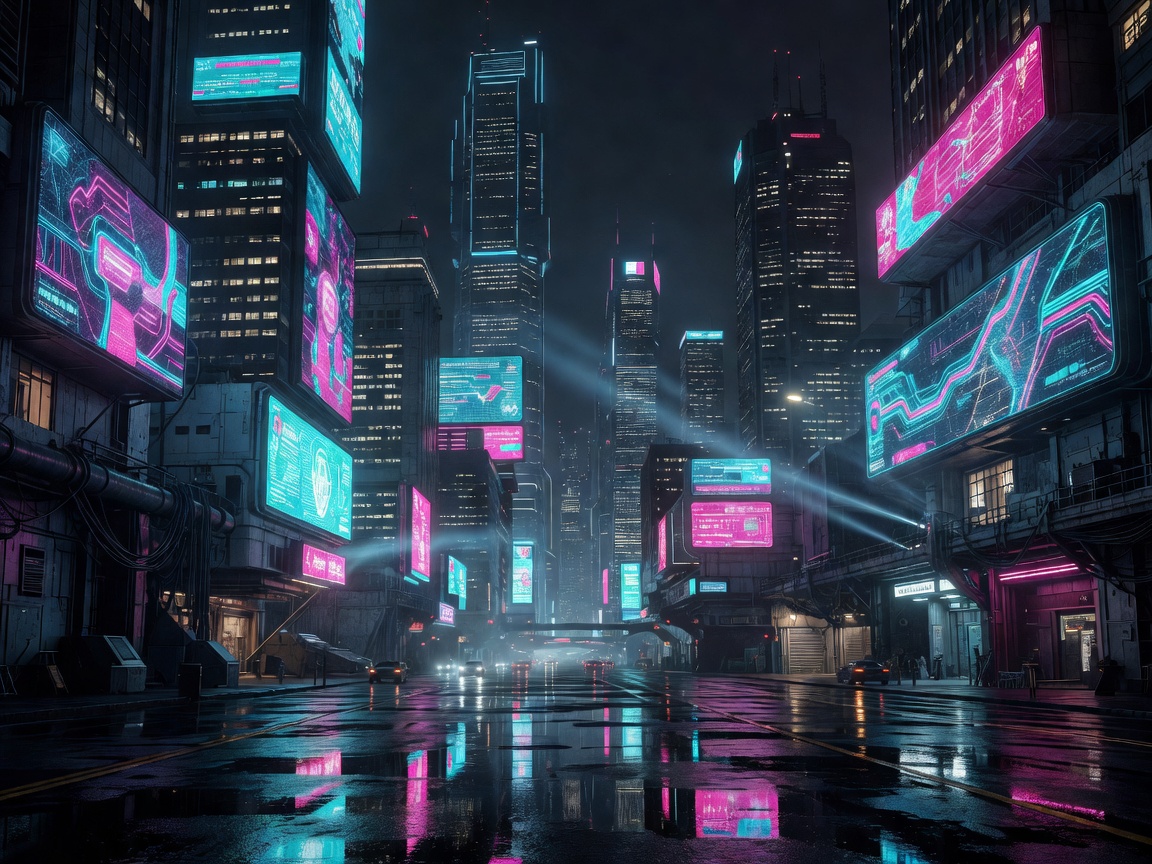
From immersive sims built around a hackable world to open-world RPGs built around a hackable body, plus the tabletop system that seeded the biggest of them.
Read the guide →Two visual lineages — Western neo-noir and Japanese animation — that arrived at the same city from opposite directions, plus what the genre owes to practical effects.
Read the guide →The Sprawl novels that named the genre, the New Wave science fiction that came before it, and the satire that eventually grew out past it.
Read the guide →How high-tech-low-life became a visual language — techwear silhouettes, multilingual signage, chrome and holography, and the music that plays under it.
Read the guide →Corporations standing in for governments, artificial minds asking for standing, surveillance as ambient weather, and rebellion that rarely wins outright.
Read the guide →The word itself is younger than the ideas inside it. Bruce Bethke titled a 1983 short story "Cyberpunk," welding a technology prefix onto a punk sensibility, and the label stuck to a loose group of writers — William Gibson and Bruce Sterling chief among them — who were already working the same territory from different angles. Sterling later collected the movement's short fiction in the anthology Mirrorshades, which did as much as any single novel to define the tone: cool, technical, unsentimental about the future.
None of it appeared from nothing. Philip K. Dick had spent the 1960s asking what separated a human mind from a manufactured one, and that question — not the chrome, the question — is the load-bearing wall the whole genre still stands on. Everything downstream, from a hacking minigame to a rain-soaked alley in an animated feature, is a different way of dramatising who gets to count as a person once the technology to fake, augment or replace one exists. The five guides on this site each pick up that argument in a different medium, and they cross-reference each other on purpose: the tabletop system behind one of the biggest cyberpunk games sits alongside the novel trilogy that gave the genre its visual vocabulary, and the same handful of recurring anxieties — corporate sovereignty, surveillance, the augmented body — show up in all of them, dressed differently each time.