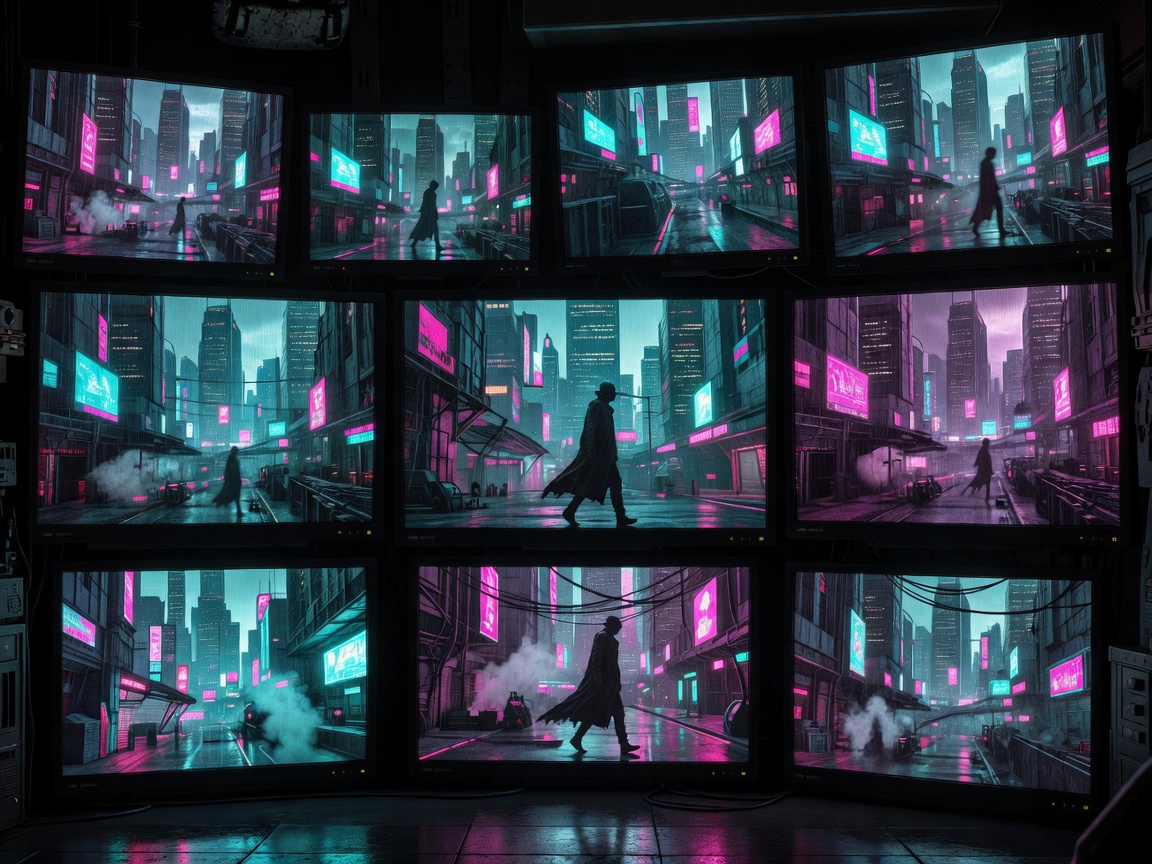
It's easy to describe cyberpunk by its surface — the rain, the chrome, the signage — but the surface is a delivery mechanism for four recurring ideas that show up across games, film and literature in different combinations. Tracking them separately makes it easier to see what a given book, film or game is actually arguing, rather than just what it looks like.
Corporations standing in for government
The most consistent structural move in cyberpunk is replacing the state with the corporation as the entity that actually governs. In Neuromancer, William Gibson's zaibatsu-style megacorporations function as the effective sovereign power, with national governments reduced to background noise. Cyberpunk 2077 inherits the same structure directly from its tabletop source material, where corporations run private security forces, control media and effectively own city districts outright. Blade Runner takes a slightly different angle — the Tyrell Corporation isn't shown running the city's politics directly, but its total, unregulated control over the manufacture of artificial life makes the point just as clearly: private enterprise, not public oversight, decides who gets made and on what terms. The consistent argument underneath all three is that once a private entity controls infrastructure, security and information at sufficient scale, the distinction between "corporation" and "government" stops doing useful work.
Artificial minds asking for standing
Do Androids Dream of Electric Sheep set the template Philip K. Dick's novel asks whether a manufactured mind convincing enough to pass every available test should be treated as a person, and refuses to give a clean answer. Ghost in the Shell pushes the same question from the other direction, following a cyborg whose organic component has shrunk to almost nothing, asking at what point augmentation becomes replacement rather than enhancement. Games handle this question more mechanically than either film or prose can: a hacking sequence that lets a player briefly inhabit or control an artificial system is a way of making the audience perform the boundary-crossing rather than just watch a character debate it.
Surveillance as ambient weather
Where older dystopian fiction tends to present surveillance as a single visible apparatus — a camera, a screen, an obvious watcher — cyberpunk more often treats it as ambient and diffuse, woven into infrastructure the characters have to use anyway. Strange Days makes recorded experience itself the surveillance technology, collapsing the distance between watching and being watched into a single recording device anyone can use on anyone else. In Cyberpunk 2077's setting, corporate and city surveillance are treated as a background condition rather than an event, something characters route around rather than confront directly, which mirrors how the theme tends to work best: not as a plot twist but as a constant, low-level pressure on how characters move through a city, closer to weather than to a checkpoint.
Rebellion that rarely wins outright
Cyberpunk protagonists are rarely revolutionaries in the sense of overturning the system they operate inside; more often they're specialists who route around it for a single job, and the genre is generally honest about the fact that one successful heist or hack doesn't dismantle a megacorporation. Neuromancer's ending is a useful example: the job gets done, the artificial intelligence at the centre of the plot gets what it wanted, and the corporate and criminal structures around the characters are essentially untouched by the outcome. That restraint is part of what separates cyberpunk from more triumphant science fiction — the genre tends to treat total victory over concentrated power as implausible, and finds its endings instead in smaller, personal outcomes achieved despite the larger system remaining intact.
Reading the four together
None of these four ideas needs the others to function, but the strongest cyberpunk work tends to run at least two at once — Blade Runner pairs corporate sovereignty with the question of artificial personhood; Cyberpunk 2077 pairs corporate power with ambient surveillance; Ghost in the Shell pairs the augmented-mind question with a surveillance-state backdrop. Treating the four as separate, trackable threads rather than a single generic "dystopian future" mood is the more useful way into any new title in the genre, cyberpunk or adjacent to it.