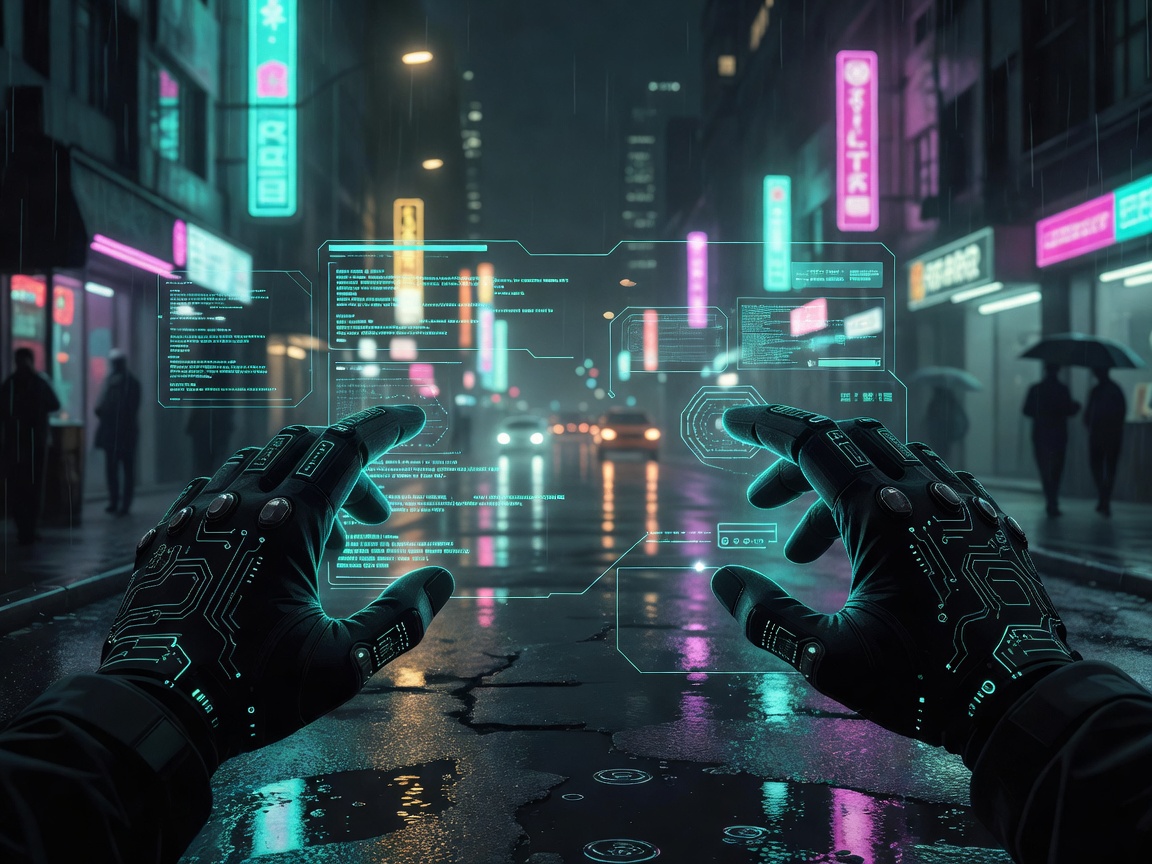
Cyberpunk earned its keep as a literary and cinematic mode first, but it found its most interactive home in games, where the genre's obsessions — corporate power, body modification, information as currency — translate directly into systems instead of staying as set dressing. Hacking a camera isn't described, it's performed; a chrome arm isn't just imagery, it's a stat block. That gives the games side of the genre a different texture from the page or the screen, and the differences between titles come down less to setting than to what kind of interaction the designers decided the future should reward.
Two lineages: immersive sim and action RPG
The clearest split in cyberpunk games runs between the immersive sim and the open-world action RPG. System Shock and its sequel System Shock 2, built at Looking Glass Studios with Irrational Games on the second entry, established the immersive sim template: a contained, densely simulated space — a space station, in that case — where the player solves problems through environmental logic rather than a fixed toolkit. Enemies, hacking puzzles and inventory management all interact with the same underlying rules, so a solution that works in one room is something you discovered rather than something the game handed you. Deus Ex, and later Deus Ex: Human Revolution and Deus Ex: Mankind Divided from Eidos Montreal, kept that DNA but widened the canvas and leaned harder into the corporate-espionage plotting cyberpunk is known for, letting players choose between stealth, hacking, dialogue and direct confrontation to clear the same objective.
Cyberpunk 2077, built by CD Projekt Red, sits in the other lineage: a large open world where the emphasis shifts from systemic puzzle-solving to narrative branching and character build variety. The city is bigger and more populated than an immersive sim's level, but the moment-to-moment problem-solving is comparatively looser — fewer emergent solutions, more scripted encounters with several viable approaches baked in ahead of time. Neither approach is a lesser version of the other; they're answering a different question. An immersive sim asks "what can you figure out," an open-world RPG asks "what kind of character do you want to have become by the end."
The tabletop root
Cyberpunk 2077 didn't invent its setting — it adapted one. Cyberpunk 2020, and its later revision Cyberpunk RED, are tabletop role-playing systems from R. Talsorian Games, built well before CD Projekt Red licensed the property. That lineage matters for a specific reason: a lot of what reads as arbitrary worldbuilding in the video game — the corporate zones, the specific street gangs, the class of cybernetic implants called cyberware — has a paper-and-dice logic behind it, developed for tabletop sessions where a game master needed clear rules for what augmentation costs a character in exchange for what it grants. Shadowrun runs a parallel case from a different angle: originally a tabletop system from FASA mixing cyberpunk with fantasy races and magic, later adapted into digital form including Shadowrun Returns from Harebrained Schemes. In both cases the video game inherits a setting that was pressure-tested for consistency at a table first, which is part of why these worlds tend to hang together better than one invented purely for a single game's marketing needs.
Body over guns: augmentation as a mechanic
The augmented body is cyberpunk's signature idea, and games are the medium best equipped to make it a decision rather than a description. In the Deus Ex series, cybernetic augmentations are a resource you allocate — more hacking capability trades against more combat capability, and the game tracks a cost for over-augmenting the body that pushes back narratively against treating upgrades as free wins. Cyberpunk 2077 handles it as a gear and build system layered onto the character sheet, where cyberware slots interact with skill trees. Ghostrunner, from One More Level, strips the idea down to pure motion: augmentation there means a single katana and a body that can wall-run and slow time, turned into a fast, punishing platformer rather than a systems game. Observer, from Bloober Team, goes the other direction entirely and uses augmentation as a horror device — the player's ability to hack directly into a suspect's memories is framed as an invasive, unstable act rather than a convenience.
Picking a starting point
What to try first depends on what you actually want from the genre. If you want systemic problem-solving where the environment itself is the puzzle, System Shock 2 or the Deus Ex series reward patience and experimentation more than any open world will. If you want a lived-in city and a character build you shape over dozens of hours, Cyberpunk 2077's open world is built for exactly that kind of accumulation. If you want the tabletop logic without the dice, Shadowrun Returns gives a shorter, more structured route into the same setting family. And if speed and reflex matter more than dialogue trees, Ghostrunner or Observer make the point that cyberpunk doesn't require an open map to land — sometimes a single corridor, lit right, does the job.