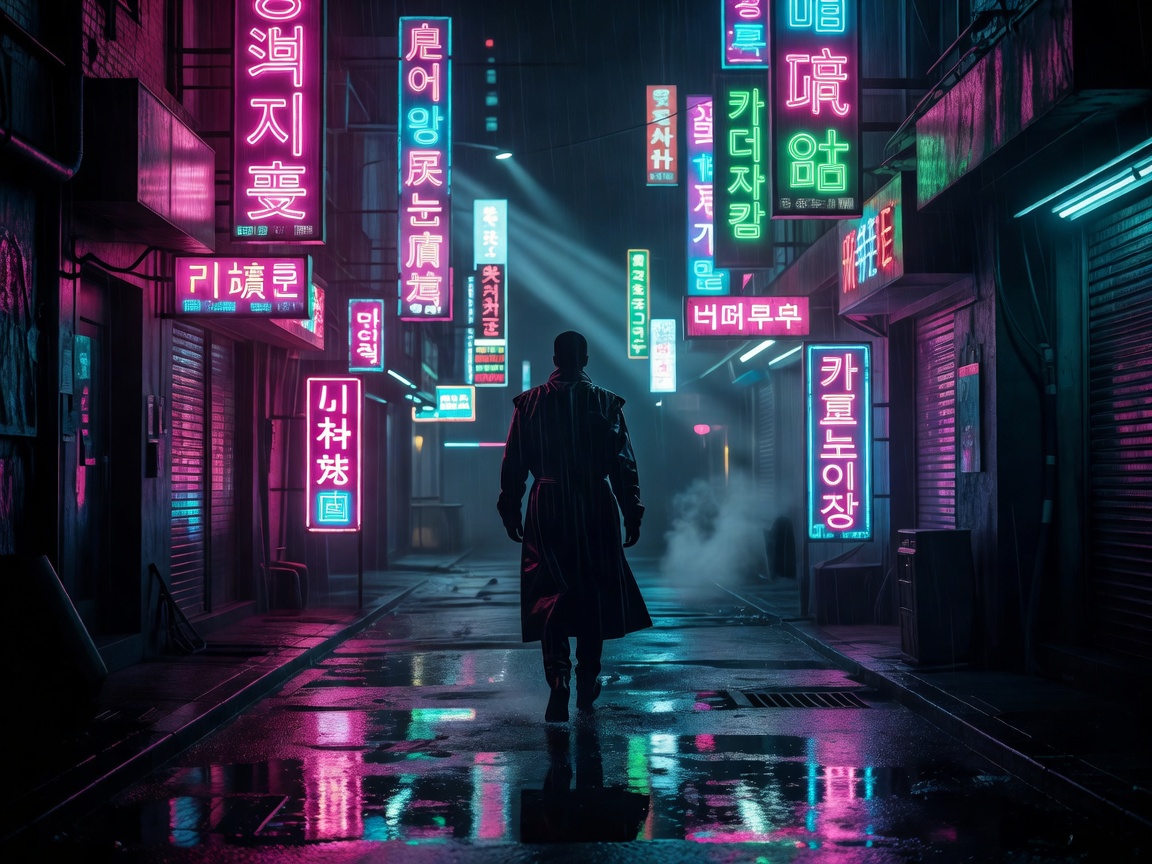
Cyberpunk on screen didn't arrive as a single tradition — it's really two, developed largely in parallel and borrowing from each other more than either side usually admits. One lineage runs through Western neo-noir detective fiction, the other through Japanese animation's own preoccupation with the body and the machine. Both ended up at the same visual destination — a wet, vertical, over-signed city — but for different reasons, and knowing which lineage a film belongs to tells you more about what to expect from it than the setting alone does.
Neo-noir's contribution: the detective in a corporate city
Blade Runner, directed by Ridley Scott, is the reference point for a reason: it took the private-eye structure of 1940s film noir — the world-weary investigator, the voiceover, the morally compromised client — and rebuilt it around a question noir had never needed to ask, which is whether the femme fatale, or the detective himself, might not be human at all. The film's visual approach mattered as much as its plot: practical miniatures, in-camera smoke and light rather than digital compositing, gave the city a physical, grimy plausibility that later purely digital cityscapes have had to work to match. Blade Runner 2049, directed by Denis Villeneuve, extended that world decades later while keeping the same commitment to physical, tangible sets over green screen wherever the production could manage it. RoboCop and Total Recall, both directed by Paul Verhoeven, sit adjacent to this lineage — less interested in the detective structure, more interested in corporate satire and body horror, but sharing the same suspicion of concentrated private power standing in for government. Strange Days, directed by Kathryn Bigelow, took the noir structure and pushed it toward surveillance and recorded experience as the central technology rather than replicants or robotics.
Japanese animation's contribution: the body as the battleground
The other lineage starts from a different anxiety: not "is this person real" but "what happens to identity once the body itself is negotiable." Akira, directed by Katsuhiro Otomo and adapted from his own manga, uses biological transformation and psychic power rather than cybernetics as its central image, but it set the template other Japanese cyberpunk animation followed — extreme scale, a city that feels like it's actively decaying, and a willingness to let the body's collapse carry the film's climax. Ghost in the Shell, directed by Mamoru Oshii, is the more direct ancestor of the "what makes a mind a person" question, following a cyborg operative whose consciousness has been so extensively augmented that the line between her and the artificial intelligence she's investigating is the entire plot. Tetsuo: The Iron Man, directed by Shinya Tsukamoto, takes the same body-anxiety and strips out the plot almost entirely, using stop-motion and practical body horror to turn man-into-machine into something closer to pure sensation than narrative.
Where the two lineages met
The Matrix, directed by the Wachowskis, is the clearest case of the two traditions fusing: a noir-adjacent chosen-one plot wrapped around visual and philosophical debts to Ghost in the Shell that the filmmakers have been open about, executed with digital effects — the bullet-time sequences especially — that pushed the genre from practical-effects craft into a new, CGI-native visual grammar other films spent years catching up to. That shift, from Blade Runner's physical miniatures to The Matrix's digital compositing, is worth tracking across any viewing list, because it changes what "neon" even looks like on screen: practical neon has a physical glow and imperfection that digital neon has to deliberately simulate.
Choosing where to start
If detective plotting and slow, atmospheric pacing appeal, Blade Runner is the correct starting point, with Blade Runner 2049 as the natural follow-up. If the philosophical question of machine consciousness matters more than plot momentum, Ghost in the Shell earns the time it asks for. For body horror and pure visual intensity over narrative clarity, Akira and Tetsuo: The Iron Man reward a viewer more interested in sensation than exposition. And for a blockbuster synthesis of both lineages with the most kinetic action set pieces of the group, The Matrix remains the widest on-ramp into the genre on screen.